
EMPLOYEE FRAUD • THEFT • MANIPULATION • INTERNAL CONTROLS

45 Ways to STEAL FROM Your Company — and How to Avoid It.
The Course You Don’t Want Your Employees to Watch Before You Do.
We identified 45 real-world ways employees, managers, vendors and executives can exploit everyday weaknesses inside a company. First, we’ll show you how they work. Then we’ll show you the warning signs — and what you can do to make them harder to happen.

$59
$99
could someone do this Inside your company?

The Ghost Employee
Could someone collect a paycheck for an employee who doesnt exist?

The Friendly Vendor
Could someone steer purchases toward a vendor that’s secretly rewarding them?

The Split Purchase
Could someone divide a large purchase into smaller transactions to bypass your approval limits?

The Phantom Expense
Could legitimate-looking expenses hide illegitimate reimbursements?

The Slow Disappearance
Could inventory disappear gradually enough that nobody notices?

The Perfect Numbers
Could someone manipulate information so a bad month looks surprisingly good?
If you Dont´t Know exactly How you´d Detect it, that´s the Problem.
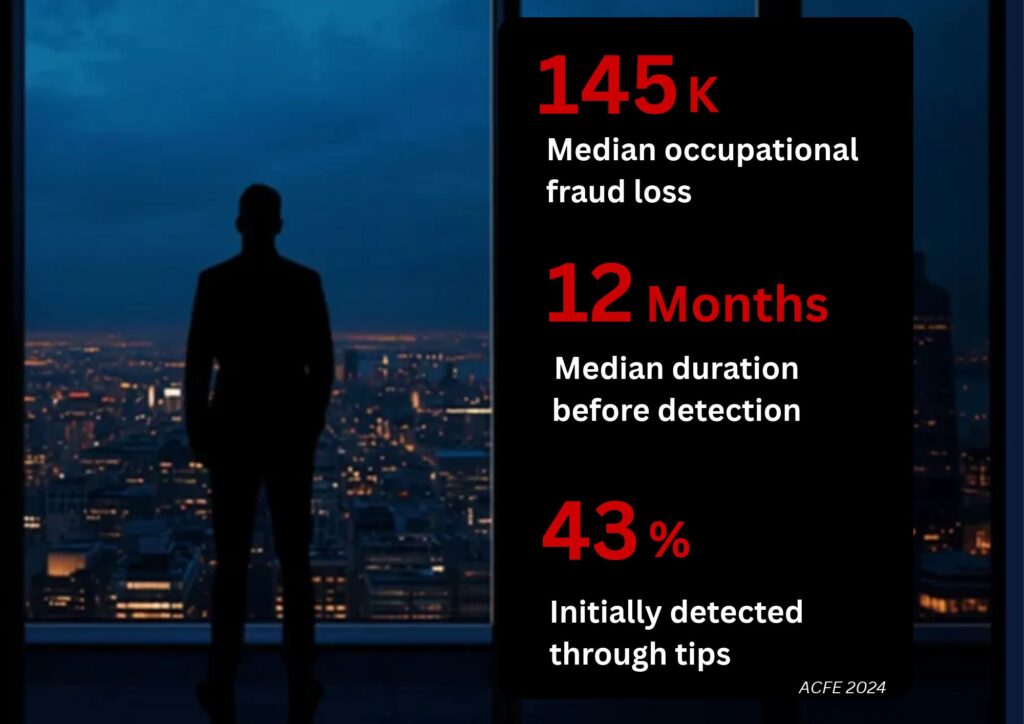
what If You Looked at Your Company Like Someone Trying to Steal From It?
Businesses don’t lose money only because dishonest people are clever. They can lose money because ordinary processes create opportunities nobody is watching. So we approached fraud prevention from the opposite direction, we asked an uncomfortable question:
“If you wanted to rob a company from the inside, how would you do it?”
Then we reversed every scheme:
How would it work?, Why might nobody notice?, What would give it away?, What could make it harder to happen?
built for People who Protect Business
You don´t need to become a Fraud Investigator. You need to know where to look

Built From Experience
25+ Years Inside Real Businesses
45 Ways was developed from decades of professional experience across business intelligence, market research, commercial strategy and different areas of business operations. Over the years, one lesson kept appearing: The weaknesses that hurt businesses aren’t always sophisticated. Sometimes they’re surprisingly ordinary. That’s why 45 Ways wasn’t designed as another academic course about fraud terminology. It was built around a practical question: “Could someone actually do this here?” And then: “How would we know?”
The Complete Course
45 Ways to Steal From Your Company – And How to Prevent It.
you Get:
SPECIAL LAUNCH PRICE
$59
$99
the Authors.
25 years. Dozens of industries. Thousands of cases
Over a 25-year career spanning forensic accounting, corporate investigations, and executive risk consulting, as a group we´ve uncovered fraud across every function of the business — from the mailroom to the C-suite. We´ve worked with publicly traded companies, family businesses, nonprofits, and government entities. What we found along the way is that most fraud is entirely preventable — once you know what to look for.
This course is the distillation of everything we´ve learned across hundreds of real cases: the patterns fraudsters rely on, the blind spots organizations create, and the exact controls that stop fraud before it starts.